Part I - Report Overview
ITEM 1. Disclaimers, Disclosures and Notes
Introduction
These financial statements were prepared by Cowrie – Administrator Services LLC ("CAS" or "Cowrie – Administrator Services"), which has been authorized as a member of DUNI to perform a variety of administrative responsibilities, including the preparation of quarterly and annual financial statements in support of quarterly tax updates.
The Quarterly Financial Statements (“QFS”) for DUNI for the three-month period ended June 30, 2026 also includes the calculation of estimated U.S. federal income tax liabilities, conducted in accordance with the current standards, rules, and interpretive guidance under the Internal Revenue Code (“IRC”) and relevant US Treasury regulations.
Purpose and Basis of Presentation
The preparation of these financial statements is guided by a primary objective: to analyze the financial activities of DUNI with the express intent of estimating its potential U.S. federal and state income tax obligations. The QFS were not prepared under Generally Accepted Accounting Principles (“GAAP”). Rather, Administrator Services has selectively employed GAAP-informed principles and valuation methodologies where necessary to ensure internal consistency, defensible estimations, and analytical rigor. Please refer to the ITEM 3. Accounting and Tax Policy section below for further discussion.
These statements do not fall under the purview of AR-C Section 70 of the AICPA Code of Professional Conduct, which governs the preparation of financial statements, as the preparation is auxiliary to our core tax engagement services. Likewise, AR-C Section 80 and AR-C Section 90 do not apply because we are not performing compilation or review services, respectively.
It is essential to emphasize that these financial statements are exclusively intended for DUNI’s internal use and limited to the specific purposes outlined above. The methodology and scope of this report are tailored to the unique operational characteristics and decentralized governance model of the entity. Furthermore, while DUNI has influence over certain structural parameters of the Uniswap Protocol (the “Protocol”), it does not exert ownership or managerial control. Accordingly, the financial results and associated tax estimates presented here do not include or reflect broader financial activities occurring at the protocol layer or among unrelated stakeholders within the Uniswap ecosystem.
Source of Financial Data
The decentralized nature of DUNI imposes distinct challenges with respect to the sourcing and consolidation of financial data. Unlike traditional enterprises that maintain centralized financial systems, there is no internal finance department. Accordingly, Cowrie – Administrator Services compiled financial data exclusively from blockchain transaction records associated with DUNI-controlled wallets (“Treasury Wallets”) and from offchain transactions executed under the scope authorized by DUNI (e.g., vendor payments, tax payments, interest earned on bank account balance).
Nature and Limitations of the Financial Statements
The QFS prepared herein do not constitute audited financial statements and do not purport to meet the disclosure or presentation requirements applicable under SEC rules or AICPA and PCAOB audit standards. These financial statements have not undergone an audit or review by an independent third party. Cowrie – Administrator Services is not an accounting firm and cannot guarantee the absence of material misstatements.
Accordingly, these financial statements should not be relied upon to detect misstatements, irregularities, fraud, or noncompliance with applicable laws and regulations. The absence of a centralized control environment and the pseudonymous nature of blockchain transactions mean that financial reporting under a DUNA model is subject to novel risks, including incomplete records, classification uncertainty, and data omissions.
It is essential that users of these financial statements exercise discretion and interpret the contents as a best-effort, good-faith, and methodologically sound approximation of DUNI’s financial activity within the defined reporting period. These statements should not be regarded as comprehensive or verified financial records. They are not a substitute for independently audited financial statements and are provided without any warranties, express or implied, as to their completeness or accuracy.
ITEM 2. DUNI
Uniswap DUNA Overview
DUNI is the membership body comprised of participating governance tokenholders with governance rights over the UNI tokens held in the DUNI Treasury and governance of DUNI. Prior to establishing as a DUNA, the governance tokenholders were referred to as a decentralized autonomous organization (“DAO”), which was created in September 2020 as a result of the launch of the UNI governance token. On September 10, 2025, members of the DAO approved Establish Uniswap Governance as "DUNI," a Wyoming DUNA to adopt a DUNA legal entity structure under the laws of Wyoming.
Membership in DUNI results from holding UNI tokens and actively participating (e.g., voting, delegating, submitting proposals, or staking); mere token ownership without participation does not constitute membership.
Members do not own DUNI’s property and per-capita distributions are prohibited other than upon windup and dissolution.
DUNI’s mailing address is:
DUNI
3306 Kelley Drive
Suite 1106
Cheyenne, WY 82001
Tax Election
Upon formation, Cowrie – Administrator Services obtained a federal Employer Identification Number on behalf of DUNI under the name DUNI Network Collective, d.b.a. DUNI.
DUNI has initiated proceedings to attain corporate tax treatment retroactive to September 2020, and the tax section is prepared as if that were the case. Accordingly, these documents apply the standard 21% US federal income tax rate for corporations to DUNI. DUNI has not elected to be treated as a tax-exempt entity under section 501(c) of the Internal Revenue Code.
Tax Reporting
While DUNAs are not required to maintain member listings, both DUNI and recipients of any outbound disposition from the DUNI Treasury must comply with relevant tax reporting requirements.
Treasury and Ecosystem Funding
As of June 30, 2026, the DUNI Treasury contains: 275,104,000 UNI tokens and 1,178,187 ARB tokens.
DUNI’s use of the treasury is determined by its governing principles, which provide token governance procedures for submitting and approving proposals.
Uniswap Protocol
Uniswap Protocol is a DeFi platform that facilitates the trading of ERC-20 tokens through a system of automated market makers (“AMMs”). Instead of using a traditional order book to match buyers and sellers, the Protocol relies on liquidity pools and smart contracts on the Ethereum blockchain to algorithmically determine trade prices. Users of the Uniswap Protocol prior to September 1, 2020 received UNI tokens based on activity, with additional allocation for historical contributions.
The UNI token provides the mechanism for membership in DUNI, as holders are able to engage in governance decisions around the functionality of existing parameters within the smart contracts and to vote on how the UNI token contained in the DUNI Treasury is utilized.
ITEM 3. Accounting and Tax Policy
Overview of Accounting and Tax Policy Framework
Cowrie – Administrator Services prepared the special-purpose QFSs for DUNI to evaluate its revenues and expenses with the ultimate objective of estimating potential U.S. federal and state income tax liabilities. This section outlines how DUNI manages its financial reporting and tax obligations. The aim is to ensure a clear, consistent method for recognizing income and expenses, ultimately enabling the estimation of potential U.S. federal and state tax liabilities.
An accounting method is the set of rules that determines when and how income and expenses are recognized on financial statements and tax returns. An entity can use different methods for financial book vs. tax purposes (e.g. accrual for financial statements, cash for taxes), but whichever methods are chosen must clearly reflect income and be applied consistently year to year. Once an entity adopts a method, it must continue with it in subsequent years barring a justified change. In DUNI’s case, both financial reporting and tax reporting use the accrual basis, as detailed below.
Financial Reporting Approach: Accrual Method
For financial statement purposes, DUNI uses the accrual method of accounting. This provides a more accurate and comprehensive view of the DUNA’s financial situation by recognizing revenues when earned and expenses when incurred, regardless of when cash is actually transferred. Under accrual accounting, unrealized gains and losses on Designated Tokens (defined below) are recognized, and deferred tax assets/liabilities are recorded for timing differences between book and tax treatments. This approach ensures the financial statements capture the full economic activity, not just cash flows. For example, if the UNI tokens held in the DUNI Treasury appreciate during the period, that unrealized gain is reflected in the financial books (with a corresponding deferred tax liability for the expected taxable gain in the future).
Tax Reporting Approach: Accrual Method
For U.S. income tax purposes, DUNI will also report on an accrual basis. Under IRC §446, taxpayers are generally allowed to use the method of accounting they use for their own books (cash, accrual, or other) so long as it clearly reflects income.
Under an accrual method of accounting, income and expenses are reported based on when they are earned or incurred, not when cash changes hands. In plain terms, this means an accrual-basis taxpayer generally reports income in the tax year it is earned (regardless of when payment is received) and deducts expenses in the tax year when the liability is incurred (regardless of when payment is made). This approach differs from the cash method and is grounded in specific tax rules (primarily IRC § 451 for income and IRC § 461 for expenses) that ensure revenue and corresponding expenses are matched to the correct period.
Income recognition (all-events test)
For tax purposes, IRC § 451 and the related regulations require that an accrual-method taxpayer recognize income once the “all-events test” is met. This test is satisfied when all events have occurred that fix the right to receive the income, and the amount can be determined with reasonable accuracy. In practice, this generally means income is considered at the earliest of the following: (1) when the required performance or service has been provided (i.e. the earnings process is complete), (2) when payment is due from the customer, or (3) when payment is actually received – whichever occurs first. By following this rule, taxpayers ensure that revenue is reported in the correct period (for example, if the DUNA earns fees or rewards in Year X, it must include them in Year X’s income even if the cash is received later). This approach is consistent with tax authority guidance and case law enforcing early recognition once the right to income is fixed.
Expense recognition (liability and economic performance)
On the expense side, accrual-method taxpayers deduct or accrue expenses when the liability is incurred, which similarly hinges on an all-events test plus an economic performance requirement. In simple terms, a taxpayer may deduct an expense only after: (1) all events have occurred that establish the fact of the liability, (2) the amount of the liability can be determined with reasonable accuracy, and (3) economic performance has occurred with respect to that liability. Economic performance means that the underlying goods or services tied to the liability have been provided – in other words, the obligation has been “performed” either by the other party or by the DUNA, as applicable. For example, if the DUNA owes a vendor for services, the expense would be accrued in the year the vendor provides those services (fulfilling our liability), even if the payment is issued later. Only once an obligation is fixed and the service or product has been delivered (or used) is economic performance met, and the expense is incurred for income tax purposes. This rule, found in IRC § 461(h) and related Treasury regulations, ensures that deductions are not taken too early. The DUNA cannot deduct a cost until it is firmly attached to a completed transaction or service.
Revenue and Income Recognition
DUNI recognizes income from all sources including digital asset transactions in the year the income is earned, due or becomes available. This policy applies equally to financial statements and tax filings. However, a key exception involves unsolicited tokens received in DUNA-controlled wallets. In the digital asset ecosystem, it is common for unknown third parties to unilaterally send tokens, whether valuable or worthless, to publicly known wallet addresses, including those under DUNI’s control. These transfers occur without the recipient’s consent and cannot be refused at the protocol level. This means DUNI might passively receive tokens it never intended to hold.
To mitigate the risk of unintended income tax exposure, unsolicited transfers do not constitute income to DUNI when received as a matter of policy.
This formal policy means that only tokens which DUNI has intentionally and willfully transacted (termed “Designated Tokens”) will be recognized in the accounting records. As of June 30, 2026, UNI (the Protocol’s governance token), ETH and ARB are the only Designated Tokens under this definition. Any other tokens sent to the Treasury Wallets by unknown parties are ignored in the financial reports and tax computations, as they were neither solicited nor used by the DUNA. Unsolicited Designated Tokens, such as UNI or ARB sent to the Treasury Wallet by unassociated third parties, will not be included in accounting records.
Accounting for Income from Airdrops
Airdrops refer to token distribution events initiated by blockchain protocol or token projects, where tokens are allocated, typically free of charge, to select wallet addresses. These events often serve as go-to-market strategies designed to drive user adoption, decentralize ownership, reward early supporters, or stimulate onchain activity.
If DUNI actively solicits or consents to receive an airdropped token (for instance, as part of a partnership or application for a distribution), and subsequently does receive those tokens, then the fair market value (“FMV”) of the tokens at receipt will be recognized as ordinary income for U.S. tax purposes and as revenue in the DUNA’s financial statements. The FMV is determined at the time of receipt using the spot market price for the token multiplied by the quantity received. This treatment complies with U.S. tax regulations (income is recognized when you have dominion and control over assets received) and ensures the financial statements reflect all earned resources.
Notably, this recognition occurs regardless of whether DUNI immediately liquidates the airdropped tokens or holds them, and irrespective of subsequent price fluctuations. The full value at receipt is counted as income.
This policy on airdrops applies to both tax and book accounting, following IRS guidelines by treating airdropped tokens as income at the time they become the DUNA’s property.
UNI Disbursement Under Governance Consensus
One of the key functions of DUNI is to support the ongoing development of the protocol and the broader Uniswap ecosystem. In alignment with its decentralized governance model, DUNI governance proposals may authorize the disbursement of UNI tokens from the DUNI Treasury to fund protocol development initiatives or broader ecosystem growth.
When such disbursements are approved, the required amount or number of tokens is transferred to an external party or vendor based on either the nominal amount or a specified token value as determined by DUNI governance.
For U.S. federal income tax and financial reporting purposes, token disbursements from the DUNA’s Treasury are treated as comprising two distinct tax accounting transactions:
- Token Disposition: The initial transaction is treated as a sale of the disbursed tokens upon transfer from the Treasury Wallets.
- Expense Recognition: The second transaction pertains to the accounting treatment of the resulting proceeds from the token disposition.
This two-step view is required because under U.S. tax law, cryptocurrencies are property (per IRS Notice 2014-21). Spending tokens is thus not just an expense; it triggers a disposition of an appreciated asset. Below we detail each component:
Token Disposition (Capital Gain/Loss on Token Transfers)
According to IRS Notice 2014-21, 2014-16 I.R.B. 938, cryptocurrencies are classified as property for U.S. federal income tax purposes. Accordingly, when DUNI transfers out tokens from its treasury (e.g. sending UNI to a grant recipient) in exchange for property (including money) or services, it is treated as a taxable sale or exchange of those tokens at the market price at time and date of the transfer. Under IRC § 1001, the DUNA must calculate and recognize a capital gain or loss on that sale or exchange. The gain or loss is computed as follows:
Capital Gain = Gross Proceeds from Sale of Disbursed Tokens – Cost Basis of Tokens Sold
- Gross Proceeds: The value received for the tokens. In the context of a treasury disbursement, this is taken as the market price of the token at the time of the transfer multiplied by the number of tokens disbursed. Since no cash is received, DUNI will treat the tokens’ market value as the proceeds of a deemed sale.
- Cost Basis: The original value of those tokens to DUNI. For initial UNI tokens minted and received in the DUNI Treasury, the cost basis is the total number of UNI tokens deposited in the treasury multiplied by the FMV of each token determined by a valuation specialist in a token valuation report, for which ordinary income has been recognized.
All such token dispositions are reported to the IRS (e.g. on Form 8949 and Schedule D of the corporate tax return) detailing the asset, date acquired, date disposed, proceeds, basis, and resulting gain or loss. From a financial reporting perspective, the act of disbursing tokens is similarly treated as realizing any built-in gain/loss on those tokens. This ensures the financial statements reflect the economic impact of using appreciated assets to fund expenses.
Expense Recognition (Use of Token Sale Proceeds)
The second part of the transaction is recording the expense for which the tokens were used. The accounting and tax treatment depends on what the expense relates to, which must be evaluated by the nature of each disbursement to determine the proper classification:
- If the expenditure is in furtherance of DUNI’s operational mission (development, community growth, etc.), it will generally be a business expense. For U.S. tax, most ordinary and necessary business expenses are deductible under IRC §162(a). For financial statements, it will be recorded as an expense in the appropriate category (e.g. “Grants expense” or “Legal expense”).
- If the expenditure is of a type that is not deductible for tax, such as lobbying and political spending or payment of US federal income tax, then no tax deduction is taken even though it’s recorded as an expense in the financial books.
- Each expense is considered on a case-by-case basis, but they fall into common categories.
Below we outline the major expense categories that DUNI is expected to incur, with their typical tax treatment:
Major Expense Categories and Tax Treatment
Grants Awards
DUNI’s Grants Awards are a key vehicle through which DUNI funds development of the Uniswap protocol and ecosystem. It provides UNI tokens or other resources to developers, researchers, community initiatives, or other recipients that contribute to Uniswap’s growth and development.
Tax Treatment: Tokens disbursed as awards are treated as ordinary and necessary business expenses if they further the DUNA’s operations. These are deductible under IRC §162(a) as they are aimed at maintaining or expanding the Uniswap ecosystem, which is the core purpose of the DUNA.
Financial Reporting: Recorded as “Grant expenses” on the income statement in the period they are approved and distributed.
General & Administrative (G&A)
G&A covers the day-to-day expense overhead of operating the DUNA. This includes routine expenses such as software subscriptions, governance administration, treasury custody management, accounting/bookkeeping services, coordinator stipends, governance tooling, compliance and treasury management services, etc. These are the routine costs of keeping DUNI functional and are not tied to specific product development.
Tax Treatment: G&A expenses are deductible business expenses under IRC §162(a) as ordinary and necessary costs of operating the DUNA. Even as a nonprofit, the DUNA can deduct these operational costs since they directly support its activities.
Financial Reporting: Recorded as “General & Administrative Expenses” in the period incurred.
Legal
Legal expenses encompass costs for attorneys, legal filings, regulatory compliance, and any counsel retained to advise the DUNA. This includes fees for setting up the DUNA’s legal structure, drafting contracts (e.g. grant agreements), obtaining regulatory advice, and any litigation or legal defense if it arises. Essentially, this is the budget for navigating laws and regulations, ensuring the DUNA’s activities are lawful.
Tax Treatment: Legal and professional fees that are directly related to the DUNA’s operations are deductible under IRC §162(a) as ordinary and necessary expenses. (An exception would be if any portion is for something non-deductible, but generally legal fees for business purposes are deductible.)
Financial Reporting: Recorded as “Legal Expenses” on the income statement.
Political Contributions & Lobbying
This category captures any spending aimed at influencing legislation, regulation, or public policy. It could include hiring lobbyists or advocacy firms, making donations to industry advocacy organizations, or funding grassroots campaigns to educate policymakers. Transparency is critical here because these expenses can be controversial and have special tax rules. These expenses are expected to be occasional and purpose-specific (not routine operations).
Tax Treatment: Not deductible. U.S. tax law expressly disallows deductions for lobbying and political expenditures (IRC §162(e)). If DUNI spends treasury funds on lobbying efforts or political contributions, those costs cannot reduce its taxable income.
Financial Reporting: Recorded as “Lobbying Expense” or “Political Contribution” in the financial statements as an expense, which will reduce book income, but with a note that it is non-deductible for US tax purposes.
DUNA Operations
These are expenses related to compensation for services to DUNI. Although DUNI is a decentralized community, certain limited authorizations of authority are formalized through governance proposal. Operational costs could include salaries or stipends for committee members, auditors, or other agents that the DUNA engages to perform work.
Tax Treatment: These operational costs are deductible business expenses (IRC §162(a)), since they are ordinary and necessary for the DUNA to function. Paying people to execute the DUNA’s decisions is a fundamental expense of running the organization.
Financial Reporting: Recorded as “DUNA Operations” or similar expense category in the financials.
Research & Development (R&D)
R&D expenses are investments in innovation, future growth, and major improvements to the Uniswap Protocol and ecosystem. This covers spending on developing new features or products, experimenting with upgrades, auditing new protocol versions, scalability research, and academic collaborations. Unlike routine maintenance, R&D is about building the future of the Uniswap Protocol, work that may not have guaranteed success but could significantly advance the protocol if successful. DUNI may fund internal committees or external developers/researchers to undertake such projects (often via grants).
Tax Treatment: Generally, R&D costs can be deductible as ordinary business expenses (or subject to special R&D capitalization rules under IRC §174).
Financial Reporting: Recorded as “Research & Development” or similar expense category in the financials.
Sales and Marketing
This category includes spending to promote the Uniswap Protocol and grow its user base and community. Even a decentralized project benefits from outreach and marketing to drive adoption. These expenses can cover advertising campaigns, branding and design work, sponsorships of events or hackathons, community meetups, educational content creation, and programs to incentivize usage.
Tax Treatment: Marketing and promotional expenses are deductible under IRC §162(a) as ordinary business expenses. They are akin to advertising costs, which are routinely deductible.
Financial Reporting: Recorded as “Sales and Marketing Expenses” in the financial statements.
Security (Audits & Bug Bounties)
Security is paramount for a blockchain protocol. This category covers expenditures to ensure the security of Uniswap’s smart contracts and infrastructure. It includes the cost of external security audits, code review engagements, ongoing monitoring services, and bug bounty programs to reward responsible disclosure of vulnerabilities. Essentially, any funds spent to identify, prevent, or mitigate security risks fall in this bucket.
Tax Treatment: Security expenses are deductible business expenses under IRC §162(a). They are ordinary and necessary costs of maintaining a secure protocol operation. Investing in audits and bounties is akin to an insurance or quality assurance expense.
Financial Reporting: Recorded as “Security Expenses” or included under a broader engineering expense category in the financial statements.
Income Taxes
For financial reporting purposes, Cowrie – Administrator Services records income tax provisions as follows:
- Current Tax Liabilities/Assets: Based on taxable income or loss for the year, the DUNA will estimate the federal and applicable state corporate income tax due for that year. A liability is recorded for taxes expected to be paid, or an asset if there are tax refunds due to overpayments or net operating losses that can be carried forward.
- Deferred Tax Assets/Liabilities: These reflect future tax impacts from temporary differences between book accounting and tax accounting. The primary source of temporary differences for DUNI is likely unrealized gains or losses on Designated Tokens. For example, if DUNI’s treasury appreciates in value on the books (creating an unrealized gain that would increase book income), US tax law would not tax that gain until the tokens are sold. This creates a deferred tax liability, which is a future tax due when the gain is realized from sale of the appreciated treasury tokens. Conversely, if the DUNA had an expense that is recognized now for book but only deductible later for tax, that would create a deferred tax asset (i.e., future tax savings). Cowrie – Administrator Services evaluates these differences each period and records deferred taxes accordingly.
The net effect is that the financial statements’ income tax expense reflects both current taxes and deferred taxes. This gives a clearer picture of the DUNA’s total tax position.
In addition, Cowrie – Administrator Services records federal and applicable state deferred tax assets or liabilities, as appropriate, to reflect estimated future tax effects arising from temporary differences - primarily those related to unrealized gains or losses on Designated Tokens.
U.S. tax law expressly disallows tax deductions for amounts paid for current federal income tax.
Balance Sheet Presentation
On the balance sheet, DUNI’s crypto assets are classified as marketable property. This classification is due to their high liquidity – UNI and ARB can be readily converted to cash at observable market prices. The treasury’s tokens are reported at FMV as of the balance sheet date. Unrealized gains or losses from revaluing these tokens to fair value are recognized in the income statement each period. This is in line with accrual accounting and reflects economic reality, but it does create the deferred tax impacts mentioned above.
All Designated Tokens (currently UNI, ETH and ARB) that the DUNA holds will appear as assets on the balance sheet. The UNI tokens held within the treasury are a significant asset – the DUNI Treasury holds roughly $778.4 million in UNI tokens as of June 30, 2026 which are subject to market fluctuations. Using fair value accounting means the balance sheet always shows the latest market value of the treasury.
Fair Value of Designated Tokens
At each reporting date, Cowrie – Administrator Services determines the fair value of each Designated Token held in the DUNA’s treasury. The carrying value of these tokens on the balance sheet is updated to the spot price as of the last second (23:59:59 Mountain Time) of the period multiplied by the quantity of tokens held.
Using observable spot prices ensures the valuation is objective and current. Any change in value from the previous period’s valuation is recognized as an unrealized gain or loss in the income statement. If UNI’s price rose during the quarter, the gain increases net income. If the price fell, an unrealized loss would reduce net income.
In summary, the balance sheet presentation provides a clear picture of the fair market value of DUNI’s token holdings by listing its treasury at fair value. The consistent fair value policy, combined with the accounting and tax policies above, provides transparency and accuracy in how DUNI reports its financial position and performance. Each practice, from accrual accounting, to recognizing only designated tokens, to detailed expense categorization, is intended to support clear, conservative financial reporting and compliance with U.S. tax laws.
Part II - Financial Information
(Summations may not foot precisely due to rounding)
ITEM 4. Balance Sheet (unaudited) - For Informational Purposes Only
Assets:
Cash and Cash Equivalents
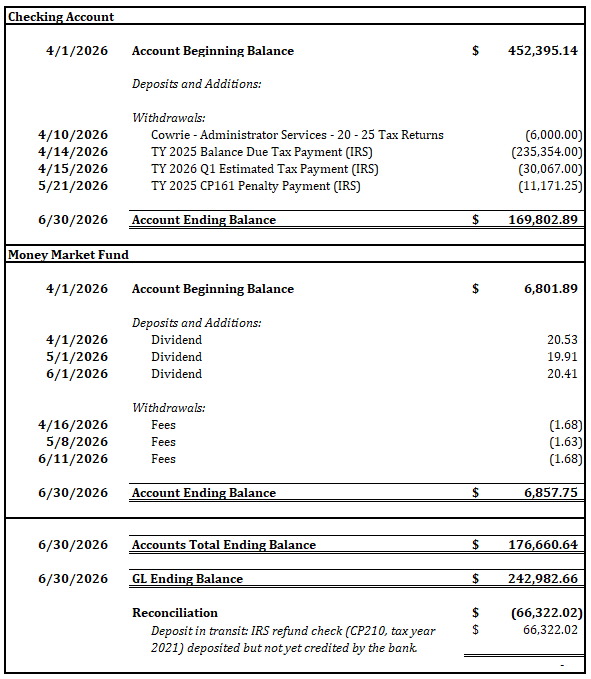
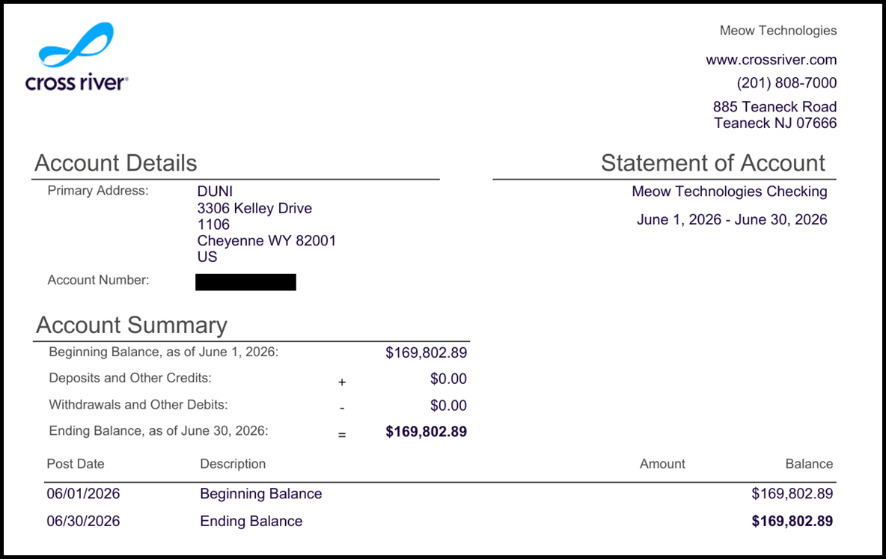
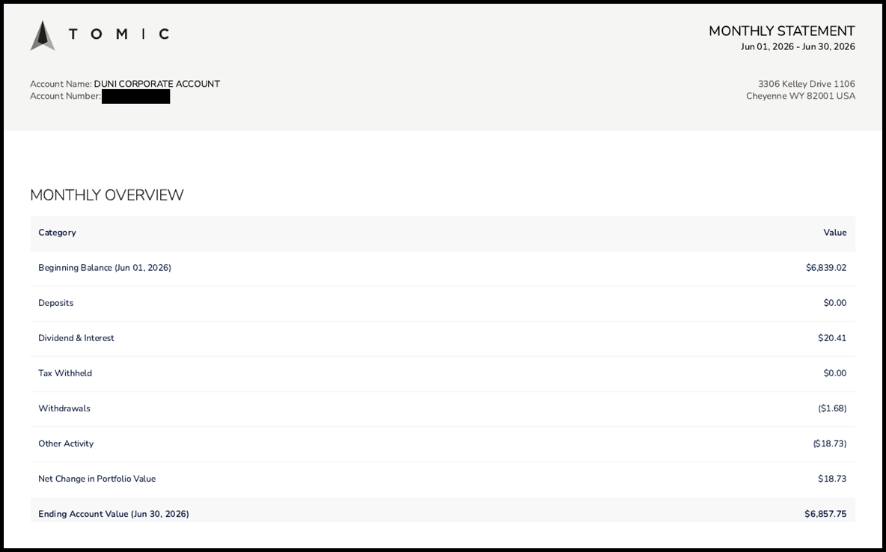
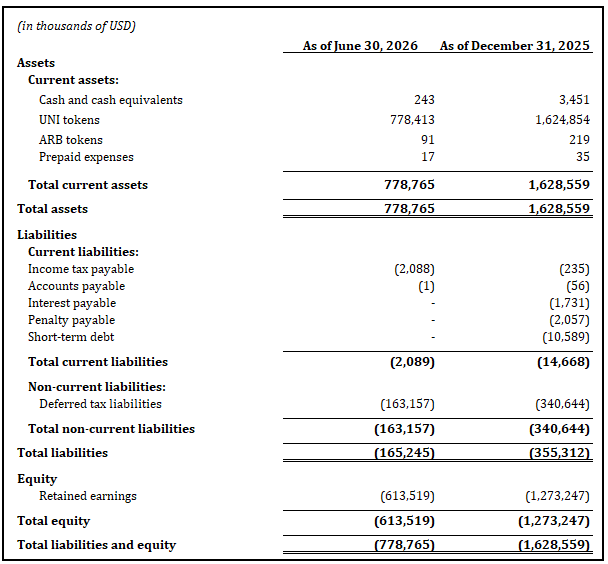
Cash and cash equivalents include cash held in checking and money market accounts. As of June 30, 2026, DUNI held $243 thousand, which includes $176.7 thousand of cash held in bank and money market accounts and $66 thousand in IRS refund checks (pursuant to CP210 Statement of Account Adjustment) received at the end of March 2026 that has not yet been deposited into the bank account. Cash on hand is designated to fund DUNI's legal expenses, tax compliance costs, and operating activities.
DUNI made federal income tax payments of $265 thousand during the quarter. These comprised the federal income tax balance due for the 2025 tax year of $235 thousand paid on April 14, 2026 and the first-quarter 2026 estimated tax payment of $30 thousand paid on April 15, 2026. DUNI also paid tax return preparation fees of $6 thousand and a federal tax penalty payment of $11 thousand (CP161 notice, paid May 21, 2026).
Digital Assets
As of June 30, 2026, DUNI's treasury held 275.1 million UNI tokens valued at $778.4 million. DUNI's treasury also held 1.2 million ARB tokens valued at $91.4 thousand. The UNI treasury position of $778.4 million remains DUNI's principal asset and is subject to market fluctuation; carrying value reflects the spot price as of June 30, 2026.
Prepaid Expenses
The prepaid expense balance relates to upfront payments to Cowrie – Administrator Services for DUNA administration services under a two-year contract term. The balance has decreased from $35 thousand to $17 thousand during 2026, as the expense is recognized ratably over the contract period.
Liabilities:
As of June 30, 2026 total current liabilities were $2.1 million (due within a year) and non-current liabilities were $163.2 million.
Short-Term Debt and Interest Payable
On April 9, 2026, DUNI settled its September 2025 collateralized financing and collar hedge with GSR Markets Ltd. Under the settlement, the loan principal of $10.6 million and accrued interest of $318 thousand were satisfied in full by set-off against the proceeds of DUNI's put-option exercise (see ITEM 5. Statement of Income); no further amounts are payable by either party. Accordingly, short-term debt of $10.6 million and interest payable of $318 thousand at March 31, 2026 were reduced to zero at June 30, 2026. The settlement agreement reflected a $2 thousand downward adjustment to interest owed, which is presented in the income statement as an offset to interest expense incurred.
Income Tax Payable
Income tax payable was $2.1 million on June 30, 2026. The balance comprises the current-quarter federal income tax accrual of $2.0 million (see ITEM 5. Statement of Income) and the unpaid remainder of the prior-quarter liability of $90 thousand, following the $265 thousand of payments made during the three months ended June 30, 2026.
Deferred Tax Liabilities
Deferred tax assets and liabilities represent the estimated future income tax effects of temporary differences between the carrying amounts of assets and liabilities recognized for financial reporting purposes and the amounts recognized for U.S. federal income tax purposes. A deferred tax liability reflects income taxes expected to become payable in future periods as those differences reverse, and a deferred tax asset reflects income tax benefits expected to be realized in future periods.
As of June 30, 2026, DUNI carried a net deferred tax liability of $163.2 million. The balance is attributable principally to the cumulative net unrealized gain on DUNI's designated-token holdings, which are carried at fair value for financial reporting purposes while the related gains are not recognized for tax purposes until the tokens are disposed of; the 21% federal corporate income tax rate applied to this cumulative unrealized position produces the deferred tax liability. No deferred tax asset for business interest expense disallowed under IRC §163(j) remained at June 30, 2026, as DUNI's projected taxable income for the 2026 tax year is sufficient to fully utilize the disallowed interest deductions carried forward from the prior year.
Equity:
Retained Earnings represent the cumulative net profits of DUNI. Each period, they roll forward pursuant to the following formula: Beginning Retained Earnings + Net Income (or – Net Loss) = Ending Retained Earnings.
For the current period, Beginning Retained Earnings are $791.4 million. Net Loss for the quarter is $177.8 million per ITEM 5. Statement of Income, resulting in Ending Retained Earnings of $613.5 million.
ITEM 5. Statement of Income (unaudited) - For Informational Purposes Only
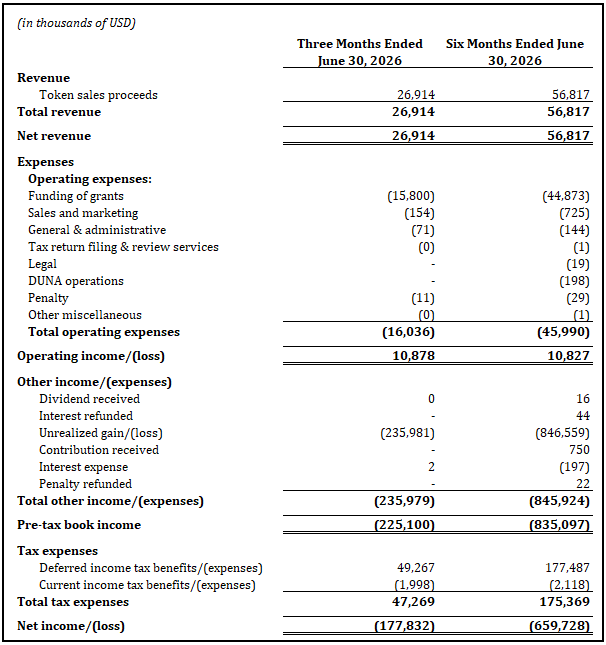
Summary of Operating Activities:
Revenue
DUNI recognized realized gains on token dispositions of $26.9 million for the three months ended June 30, 2026, compared to $29.9 million for the three months ended March 31, 2026. Because the cost basis of DUNI's treasury tokens is de minimis, substantially the full fair value of each disposition is recognized as gain. Notable dispositions during the quarter include the following:
- UNIfication quarterly distribution (gain of approximately $15.8 million): The release of the second quarterly vesting tranche of 5 million UNI to Uniswap Labs on April 10, 2026 (discussed below) constituted a deemed sale of the disbursed tokens at fair value on the transfer date.
- GSR collar settlement (gain of approximately $10.9 million): On April 9, 2026, DUNI exercised the put option under its September 2025 costless collar with GSR, which was in the money as the market price of UNI had fallen below the put strike price of $6.887465 per token. The 1.6 million UNI held by GSR as loan collateral were deemed sold at an implied price of $6.886061 per token, generating gain of $10.9 million.
Operating Expenses
DUNI's operating expenses for the three months ended June 30, 2026 totaled $16.0 million, compared to $30.0 million for the three months ended March 31, 2026. DUNI's operating expenses for the current quarter include grant awards, sales and marketing expenses, and general and administrative expenses. Notable DUNI operating expenses incurred during the current period include the following:
- UNIfication Grant: As part of the "UNIfication" proposal executed on December 28, 2025, governance approved an annual grant of 20 million UNI tokens to Uniswap Labs, which vests and distributes quarterly (i.e., 5 million UNI tokens per quarter). This growth budget is intended to fund Uniswap Protocol growth and development and is governed by a services agreement between Uniswap Labs and DUNI. The proposal approved two years of vesting (i.e., 40 million UNI tokens in total). The tokens remain in the DUNI Treasury until vested, and unvested UNI tokens may be cancelled by a vote of the governance community. The second quarterly tranche of 5 million UNI tokens ($15.8 million) was transferred from the DUNI Treasury to Uniswap Labs on April 10, 2026. Accordingly, DUNI recorded $15.8 million in expenses related to the UNIfication Grant for the three months ended June 30, 2026.
- Sales and Marketing Expense: DUNI incurred sales and marketing expense of $154.0 thousand during the three months ended June 30, 2026. This amount reflects payments of 77.2 thousand UNI ($252 thousand) to GFX Labs under the one-year maintenance term for Uniswap v3 deployments accessed through the Oku interface (cloud hosting, indexing, RPC infrastructure, and developer support). It also reflects the final distributions of the Uniswap Ecosystem Incentives Initiative ("UEII") of 10.3 thousand UNI ($32 thousand) on April 8, 2026. These amounts were partially offset by a $130 thousand credit arising from the return of 36.3 thousand UNI of undeployed liquidity-incentive funds from the Angle/Merkl distributor (the reversal of a prior-period distribution; see Item 6. Statement of Digital Assets).
- General and Administrative Expense: During the quarter ended June 30, 2026, DUNI recorded $71 thousand of general and administrative expenses. These expenses primarily comprise recurring operating payments pursuant to governance proposals previously executed, including the "Supporting Tally’s Development and Enhancements for Uniswap Governance" and the "Establish Uniswap Governance as ‘DUNI,’ a Wyoming DUNA", which support DUNI's ongoing operational activities. Expenditures during the period primarily consisted of payments to Tally for the support and development of DUNI governance and ratable recognition of the prior payment made to Cowrie – Administrator Services for income tax compliance and other administrator activities.
Other Income (Expenses)
DUNI's other expenses for the three months ended June 30, 2026 totaled $236.0 million, compared to $609.9 million for the three months ended March 31, 2026. The decline in designated-token prices during the quarter produced unrealized losses of $236.0 million, compared to $610.6 million of unrealized losses in the prior quarter. Because the tokens have not been disposed of, these losses are excluded from current-period taxable income.
Income Taxes
Income taxes comprise current and deferred amounts.
Current income tax applies the 21% federal rate to current taxable income (realized income less tax-deductible expenses). Taxable income of $9.5 million for the three months ended June 30, 2026 results in current income tax expense of approximately $2.0 million. Taxable income for the quarter reflects the deduction of $1.4 million of interest expense previously deferred under IRC Section 163(j); following the settlement of the GSR financing, no Section 163(j) carryforward remains.
Deferred income tax reflects the expected tax on current period unrealized gains or losses and other deferred tax items and is recognized when gains or losses are realized in a future period when the treasury tokens are sold or when other deferred tax items are realized in a future period. DUNI’s $236.0 million three-month period unrealized losses and other deferred tax items result in a deferred income tax benefit of approximately $49.3 million at the 21% tax rate.
DUNI is currently working with the IRS to finalize and settle prior-period obligations, and the ultimate resolution remains contingent upon the completion of that process, including a pending request for abatement of penalties to be returned to DUNI. Once the prior period obligations have been finalized, Cowrie – Administrator Services will include the prior period filed tax returns in its quarterly financial update. Any refunds of penalties and/or interest will be reflected within the financial statements of the period in which the IRS communicates the amount of the refunds.
ITEM 6. Statement of Digital Assets (unaudited) - For Informational Purposes Only
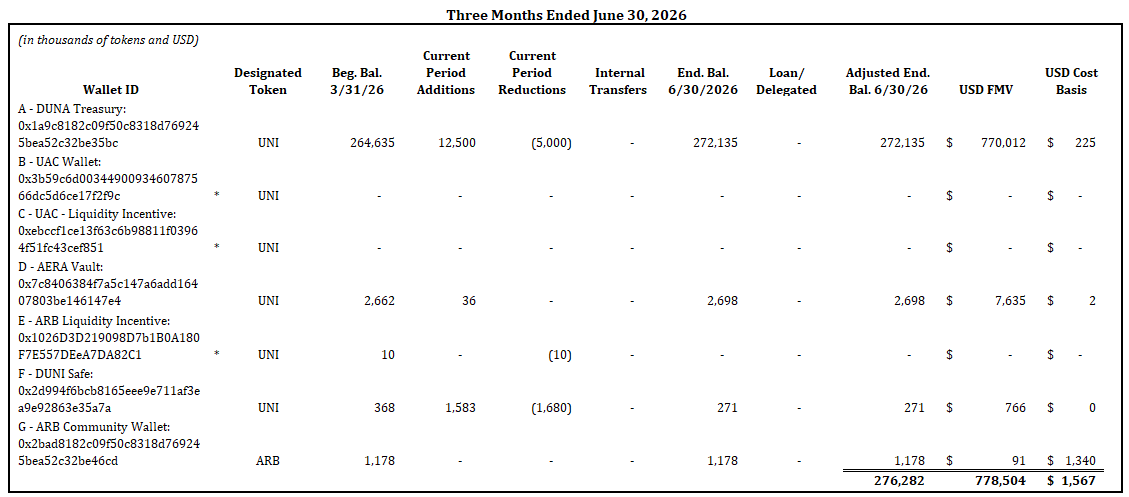
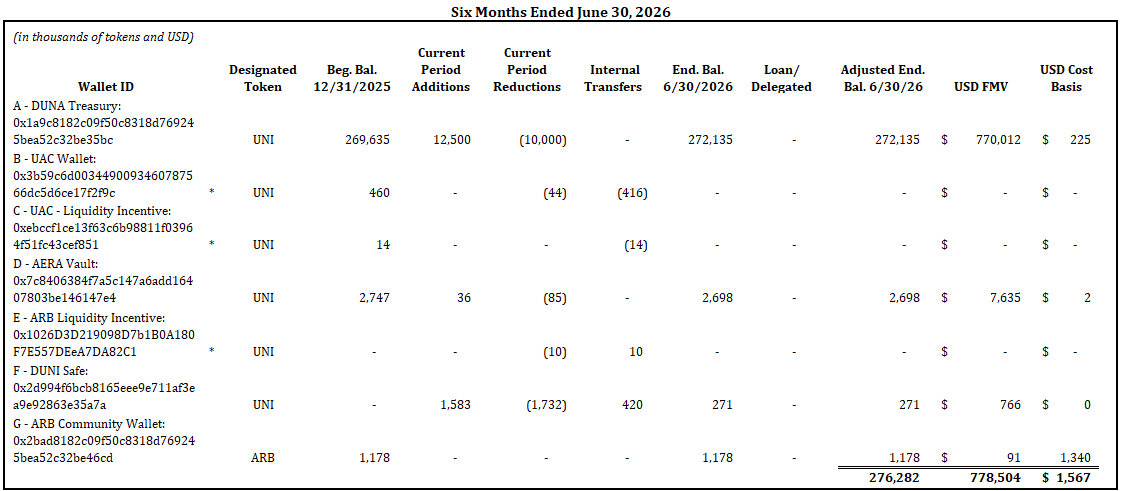
Notable digital asset movements during the quarter:
- Return of 12.5 million delegated UNI. Pursuant to the "Return 12.5M Delegated Tokens to the Governance Timelock" proposal, on June 1, 2026 the treasury recalled the UNI delegated to eight delegates through the Franchiser mechanism during 2022 and 2023, returning approximately 12.5 million UNI to the treasury's direct holdings in a single transaction. Delegation conveys voting power only and does not transfer beneficial ownership; the tokens remained DUNI's assets throughout, and the return is recorded on the Statement of Digital Assets with no income, gain, loss, or tax impact, with the tokens retaining their original cost basis. With governance participation now well established, the proposal unwound the bootstrap-era delegations to align voting power with economic exposure. The delegated-token balance at June 30, 2026 is zero.
- GSR collateral settlement. The 1.6 million UNI pledged as collateral under the September 2025 GSR financing were deemed returned and simultaneously disposed of in the put-option settlement described in ITEM 5. Statement of Income, reducing the pledged-collateral balance to zero.
* Wallets B (UAC), C (UAC - Liquidity Incentive), and E (ARB Liquidity Incentive) represent wallets operated by the UAC to administer expenditures authorized through prior governance proposals. In connection with the UNIfication proposal (Proposal #93, executed December 28, 2025), the administration of expenditures transitioned to the Ministerial Agent (Uniswap Foundation), and the UAC's operations were wound down as of February 28, 2026. In connection with the wind-down, the UNI tokens held in these wallets were either expended in fulfillment of previously authorized initiatives or returned to the DUNI Safe. All remaining tokens held by the UAC were transferred to the DUNI Safe, with the exception of 10.3 thousand UNI tokens retained in the ARB Liquidity Incentive wallet (Wallet E) to fulfill DUNI's remaining obligations under the UEII. The final UEII distribution was executed on April 8, 2026. Accordingly, DUNI relinquished control over Wallet B and Wallet C as of February 28, 2026, and activities from these wallets are excluded from the financial statements and income tax return beyond that date. Wallet E's activities remained included through the April 8, 2026 final UEII distribution; following that distribution, DUNI relinquished control over Wallet E, and its activities are excluded from the financial statements and income tax return thereafter. As of June 30, 2026, DUNI does not hold or control Wallets B, C, or E.
Note:
The Statement of Digital Assets is a standardized, supplemental report that summarizes DUNI’s digital asset positions and activity. It rolls forward wallet token balances from the beginning of the period to the end of the period, and it also provides fair market value and cost basis figures by wallet. This information allows the reader to understand the potential tax consequences of future dispositions from the DUNI Treasury.
ITEM 7. Bank Account Reconciliation (unaudited) - For Informational Purposes Only